
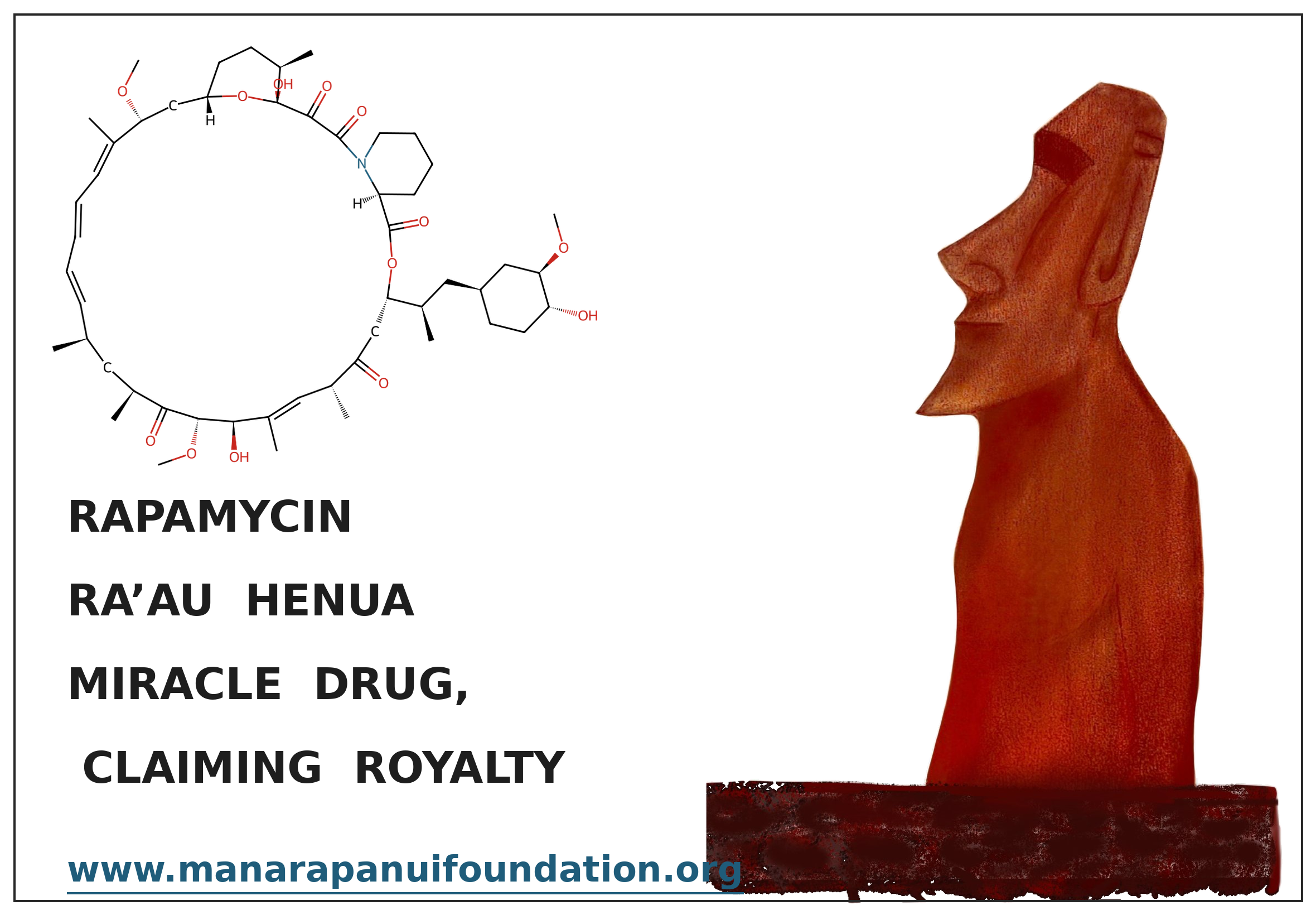
Ra’au Henua
“MEDICINE OF THE LAND” · RAPAMYCIN & RAPA NUI
Rapamycin — one of the most influential compounds in modern medicine — was discovered in the soil of Rapa Nui and carries the island’s name around the world. Yet the community whose land yielded it has never shared in its benefit.
An Opportunity for Reciprocity
Rapamycin underpins organ transplantation, oncology, and the fastest-growing area of aging research. The molecule launched a multibillion-dollar field of medicine and bears the Indigenous name of the island where it was found. Today, however, residents of Rapa Nui face persistent gaps in healthcare infrastructure, elder care, and access to basic assistive and medical devices.
Through Ra’au Henua, the Mana Rapa Nui Foundation invites pharmaceutical, biotechnology, and longevity-sector partners to help close this gap with a transparent, ESG-aligned model that links scientific heritage to measurable community impact — delivering assistive equipment now, and building a Wellness & Longevity Center on the island over time.
The Origin Story
In November 1964, roughly forty doctors and scientists set sail from Halifax, Nova Scotia, aboard a Royal Canadian Navy vessel bound for Rapa Nui. The mission — the Medical Expedition to Easter Island (METEI), backed by the World Health Organization — aimed to study the island’s people and environment before a newly built airstrip would connect this remarkably isolated community to the wider world.
Among the team was University of Montreal microbiologist Georges Nógrády, who gathered more than two hundred soil samples across the island. One sample reached the Ayerst pharmaceutical laboratories in Montreal, where biochemist Surendra “Suren” Sehgal and bacteriologist Claude Vézina isolated a bacterium — Streptomyces hygroscopicus — that produced a powerful new molecule. They named it rapamycin, after Rapa Nui.
The compound nearly disappeared. When Ayerst closed its Montreal facility, the program was slated for cancellation and the samples for destruction. Convinced of its value, Sehgal preserved a sample at home until research could resume — an act of persistence that ultimately brought rapamycin to market in the late 1990s. From the soil of one of Earth’s most remote islands, a global medicine was born.
Scientific Importance
Rapamycin · C₅₁H₇₉NO₁₃
Rapamycin’s first major role was as an immunosuppressant: approved in the late 1990s as sirolimus (Rapamune), it became essential in preventing organ-transplant rejection and in drug-eluting coronary stents. Its deeper significance lies in how it works — by inhibiting a master regulatory pathway named after the drug itself, mTOR (the mechanistic target of rapamycin), which governs cell growth, metabolism, and survival. This has made rapamycin one of the most studied molecules in biology and a central tool in the science of aging.
An honest view of the longevity evidence
In animal studies, reducing mTOR activity has extended lifespan, and an overactive mTOR pathway is linked to many age-related conditions. In the interest of credibility, we state the evidence plainly: as of 2025, the dramatic lifespan results seen in animals have not yet been demonstrated in healthy humans. Early clinical trials suggest low-dose rapamycin can be reasonably well tolerated and may produce modest changes in markers of biological aging, but long-term human benefits remain unproven, and larger trials are needed.
WHY THIS MATTERS TO PARTNERS
This initiative does not depend on rapamycin’s longevity promise being proven. It rests on the molecule’s established scientific stature and its undisputed origin in Rapa Nui. Honesty about the science strengthens — rather than weakens — a partner’s reputational position.
The Ethical Gap — and a Leadership Opportunity
A molecule drawn from Rapa Nui’s soil launched a major pharmaceutical industry and an entire field of research. Yet the people of Rapa Nui shared in none of its proceeds, and many islanders today lack access to basic assistive devices and medical equipment.
This is not a grievance the Foundation invented; it is a question now being raised within the scientific community itself — what researchers and companies owe the Indigenous communities and lands from which discoveries are drawn. We frame this not as a debt to be demanded, but as a leadership opportunity: a chance for a forward-looking partner to be the organization that closes the loop, connecting scientific heritage to tangible benefit for the originating community.
The Solution: A Two-Phase Initiative
PHASE 1 · IMMEDIATE
Assistive Equipment Deployment
Direct delivery of wheelchairs, walkers, mobility aids, and essential medical devices to islanders and elders who currently lack them. Fast, visible, measurable impact.
Target: [ X wheelchairs, Y walkers, Z devices ] within [ 12 months ]. Estimated cost: [ $ amount ].
PHASE 2 · LONG-TERM
Wellness & Longevity Center
A permanent center on Rapa Nui integrating healthcare delivery, elder care, and sustainable operations — a lasting institution that honors the island’s heritage as a place of healing.
Scope: [ facility size / services ]. Estimated cost: [ $ amount ].
“The molecule carries the name of Rapa Nui worldwide. This initiative ensures its legacy returns through measurable impact.”
Partnership & Investment Structure
| PARTNERSHIP TIER | COMMITMENT | ILLUSTRATIVE BENEFITS |
|---|---|---|
| Flagship Partner | $1M+ | Naming opportunity, leadership role on initiative, premier recognition, executive engagement. |
| Strategic Partner | $500K – $1M | Prominent recognition, program co-branding, impact reporting and engagement. |
| Supporting Partner | $100K – $500K | Named recognition, impact updates, acknowledgment across Foundation channels. |
Tier benefits are illustrative and confirmed in a written partnership agreement. Naming and recognition opportunities are offered at the Foundation’s discretion.
Join Ra’au Henua
Read the full investor & strategic partnership white paper, or support the work directly.
Mana Rapa Nui Foundation — 501(c)(3) Nonprofit Organization · Durham, North Carolina, USA
EIN [ EIN number ] · Partnerships: [ partnerships@… ] · manarapanuifoundation.org
Scientific statements reflect the state of published evidence as of 2026 and are informational only; rapamycin is not approved as an anti-aging therapy. This page is for partnership discussion and does not constitute an offer of securities or investment advice.